
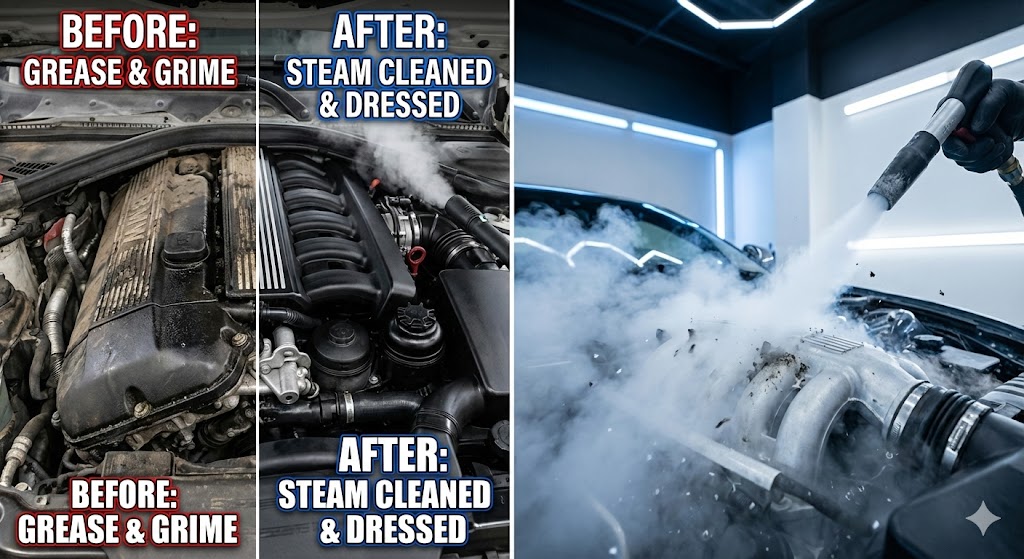
You wash the paint, vacuum the mats, and even shine the tires. But when was the last time you popped the hood?
For most drivers, the engine bay is a “no-go zone”—a dark, greasy abyss filled with scary wires and sensors. The fear is real: “If I spray water here, will my car start?”
In 2026, Engine Steam Cleaning has emerged as the safest, most effective solution to this problem. Unlike the risky “pressure washer” method of the past, steam uses low-moisture vapor to melt away years of oil sludge without flooding sensitive electronics.
But is it worth paying a pro? Or should you rent a steamer? This guide breaks down the 2026 Engine Steam Cleaning costs, compares it to the premium Dry Ice Blasting, and answers the burning question: Is it safe for Hybrids and EVs?
1. Engine Steam Cleaning Cost 2026 (National Averages)
The price varies significantly depending on whether you visit a quick-lube shop or a dedicated detailer.
The “Add-On” Warning: Many tunnel car washes offer an “Engine Clean” for $40. Avoid this. They typically use a high-pressure power washer, which can force water into your alternator or fuse box. True steam cleaning requires a human with a specialized wand, not a machine.
2. The Premium Option: Steam vs. Dry Ice Blasting
If you own a Porsche, Corvette, or a vintage muscle car, you have likely heard of Dry Ice Blasting. In 2026, this is the hottest trend in high-end detailing.
Steam Cleaning ($125): Uses hot vapor (212°F+) to melt grease. It leaves a small amount of moisture. Excellent for daily drivers (Toyota, Ford, Honda).
Dry Ice Blasting ($350+): Shoots frozen CO2 pellets at supersonic speeds. Upon impact, the pellets sublimate (turn to gas), freezing and shattering the dirt.
Advantage: Zero moisture. It is the only 100% safe method for delicate classic cars or Ferraris with exposed wiring.
Result: It restores rubber and plastic to factory matte finish, whereas steam requires a dressing to look shiny.
Recommendation: For a 2020 Honda Civic? Get a Steam Clean. For a 1969 Mustang or a 2026 Porsche 911? Pay for Dry Ice.
3. Is Engine Cleaning Safe? (EVs & Hybrids)
This is the #1 fear. With modern cars having more computers than a spaceship, is steam safe?
For Internal Combustion Engines (ICE): Yes, if done by a pro. They will cover the Alternator, Air Intake, and Fuse Box with plastic bags before starting. Steam is far safer than a hose because it uses 90% less water.
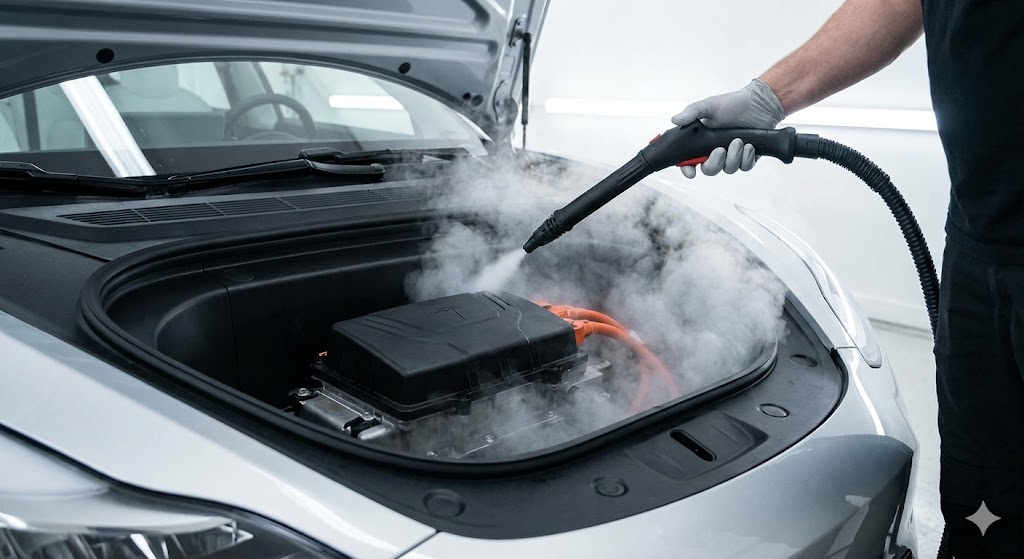
For EVs (Tesla, Rivian, Hyundai Ioniq): Actually, EVs are easier to clean.
The Myth: “Water will electrocute the battery.”
The Reality: High-voltage components (Orange Cables) are completely sealed and waterproof (IP67 rated).
The Risk: You typically don’t need to steam clean an EV “engine” (frunk area) often because there is no oil to leak! A simple wipe-down with a damp microfiber is usually enough. If you do steam it, avoid directing the nozzle at the 12V battery terminals.
4. Why Should You Clean Your Engine? (ROI)
It’s not just about vanity. A clean engine pays for itself in three ways:
Leak Detection: It is impossible to find a small oil or coolant leak if your engine is covered in 5 years of sludge. A clean engine helps your mechanic spot issues before they become catastrophic failures.
Cooling Efficiency: A layer of dirt acts as a “blanket,” trapping heat. Removing it allows the engine to dissipate heat effectively, extending the life of rubber hoses and gaskets.
Resale Value: This is the big one. When selling a used car, a clean engine bay screams “This car was pampered.” It can increase your private party sale value by $300 – $500.
5. DIY Steam Cleaning: Can You Do It Yourself?
Yes, but the equipment matters. You cannot use a garment steamer. You need a pressurized steam canister (like a McCulloch or Dupray).
DIY Cost Breakdown:
Home Steam Cleaner: $140 (One-time buy).
Engine Degreaser (Koch Chemie Green Star): $18.
Detailing Brushes: $10.
Plastic Dressing: $15.
Total Setup: ~$185 (Pays for itself after 2 uses).
The Process:
Cover alternator/battery with plastic.
Spray degreaser on a cool engine (never hot!).
Agitate with brushes to loosen grime.
Steam away the sludge.
Dress plastics while still warm for a deep black finish.
6. Frequently Asked Questions
Q: Will Jiffy Lube steam clean my engine? A: Generally, no. Most quick-lube places do not offer this due to liability risks. You are better off finding a local “Mobile Detailer” on Google Maps.
Q: Does steam cleaning remove rust? A: No. Steam removes oil and dirt. To remove rust from engine parts, you would need Dry Ice Blasting or laser cleaning.
Q: How often should I do this? A: Once a year is sufficient for most drivers. If you live on a dirt road or have an oil leak, do it every 6 months.
Conclusion
In 2026, Engine Steam Cleaning is a smart maintenance investment, not just a cosmetic luxury. For around $125, you protect your engine from overheating, make repairs easier, and boost your resale value.
If you have a high-end vehicle, consider upgrading to Dry Ice Blasting for the ultimate water-free restoration.
Ready to find a pro? Search for “Steam Detailers” rather than “Car Washes” to ensure you get a trained technician, not a teenager with a pressure washer.

