
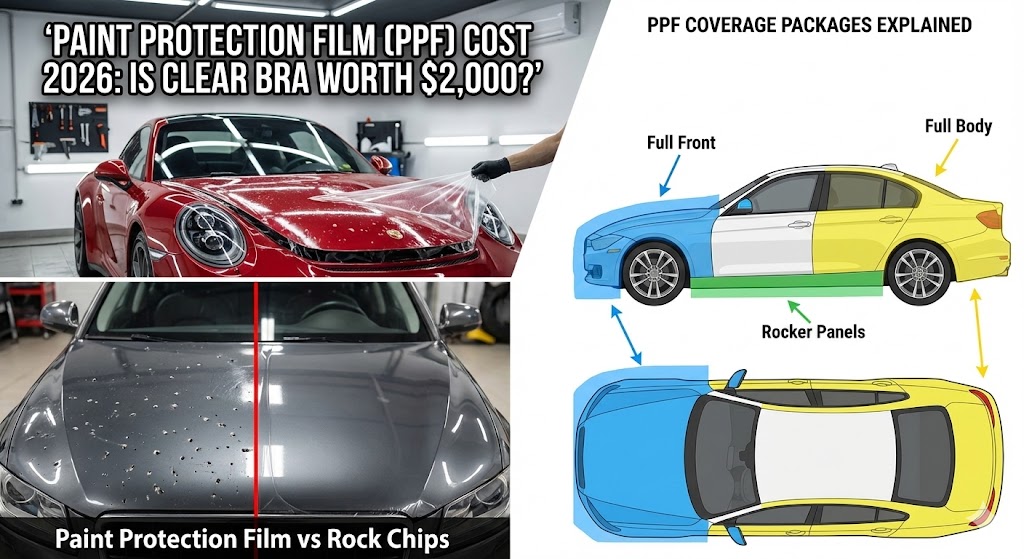
You just drove your brand new car off the lot. You are cruising down the highway, admiring the paint, when suddenly—SMACK!
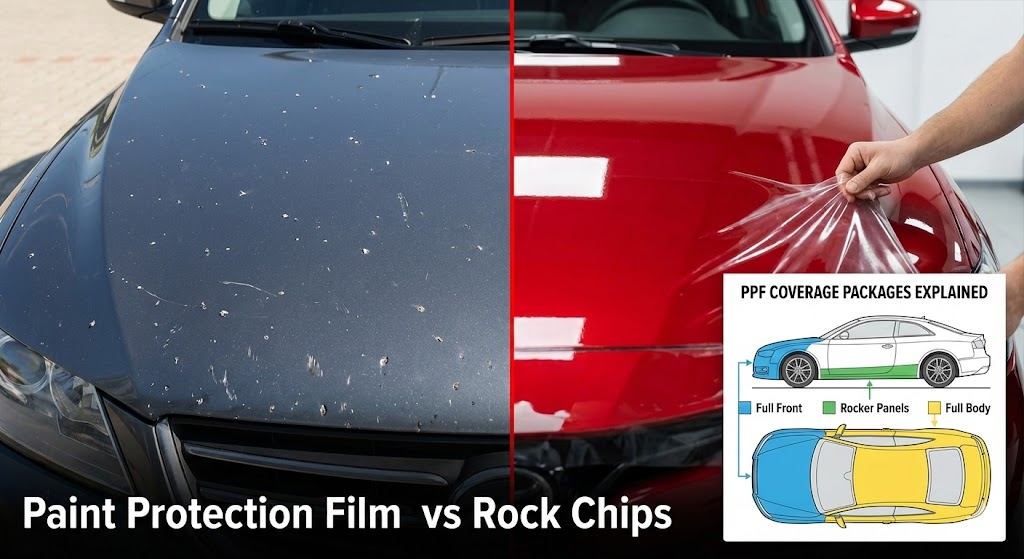
A dump truck kicks up a rock, and it chips your pristine hood. Your heart sinks.
In 2026, Paint Protection Film (PPF)—often called “Clear Bra”—is the only scientifically proven way to stop rock chips, scratches, and road debris from ruining your car’s value. Unlike Ceramic Coating, which is a liquid chemical, PPF is a thick, physical layer of urethane armor.
But with quotes ranging from $900 to $8,000, is it actually worth the investment? Or is it just an upsell from the dealership?
This guide breaks down the real PPF prices for 2026, compares the top brands like XPEL and 3M, and explains exactly which parts of your car you actually need to cover.
1. Paint Protection Film Cost 2026 (National Averages)
PPF pricing is not based on the size of the car as much as the complexity of the installation. It is a labor-intensive art form.
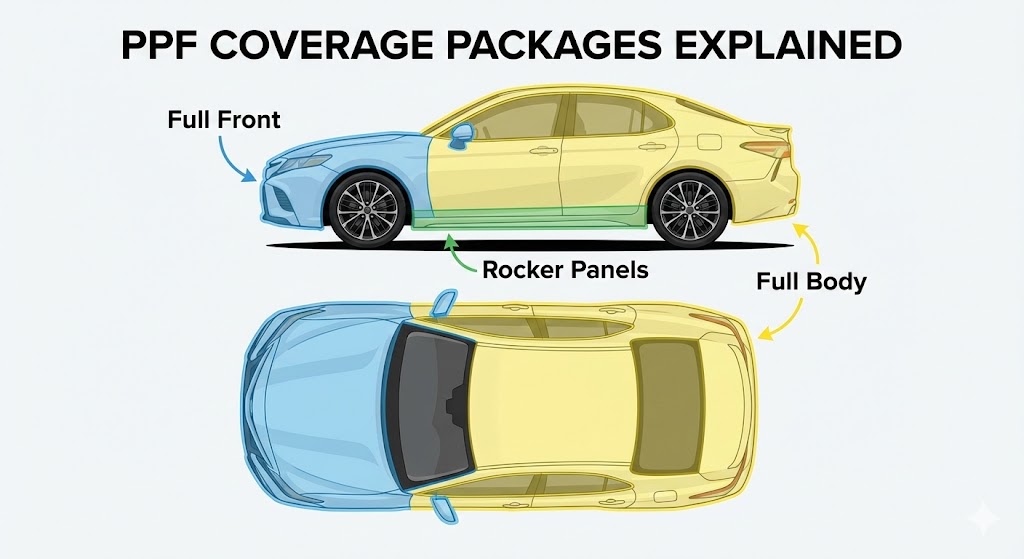
Here are the four standard packages offered by professional detailers in 2026:
The “Bikini Line” Warning: If you choose the Partial Front package, you will see a visible line across your hood where the film stops. Over time, dirt collects here. Most luxury car owners in 2026 opt for the Full Front to avoid this ugly line.
2. PPF vs. Ceramic Coating: What’s the Difference?
This is the #1 question we get.
Ceramic Coating (Cost: $1,500): Think of it as “Super Wax.” It makes the car shiny and easy to wash. It protects against UV rays and bird poop. It DOES NOT stop rocks.
Paint Protection Film (Cost: $2,000): Think of it as “Invisible Phone Screen Protector.” It is a thick plastic film. It absorbs the impact of rocks. It has “self-healing” properties (scratches disappear in the sun).
The Ultimate Combo: Most high-end detailers recommend: PPF on the front (to stop rocks) + Ceramic Coating on the whole car (for shine and ease of cleaning).
3. Brand Matters: XPEL vs. 3M vs. SunTek
Not all plastic is created equal. In 2026, you are paying for the film’s clarity and adhesive technology.
XPEL Ultimate Plus: The market leader. Known for its excellent self-healing top coat and comprehensive warranty (usually 10 years).
SunTek Reaction: A “2-in-1” film that has ceramic coating properties built into the PPF itself. Very hydrophobic.
3M Scotchgard Pro: The classic choice. Extremely durable, but some older versions were known to yellow (new 2026 versions have fixed this).
Tip: Ask your installer which brand they use. If they use a generic “house brand,” walk away. You want a warranty that is valid nationwide.
4. Maintenance: Can You Wash a Wrapped Car?
Yes, but you have to be careful.
Automatic Washes: Avoid. High-pressure jets can lift the edges of the film, and aggressive brushes can mar the soft surface. Read our guide: Can You Go Through a Car Wash with PPF?
Touchless Washes: Generally safe, but be careful with high-pH soaps which can dry out the urethane over time. (Touchless Wash Guide).
Hand Wash: The best method. Use the two-bucket method or a rinseless wash. (Hand Car Wash Prices).
5. Is It Worth the Money? (ROI Analysis)
Let’s look at the math.
Scenario A: You lease your car.
Verdict: No. Why protect the paint for the dealership? Unless it’s a high-end lease with strict damage penalties, save your money.
Scenario B: You plan to keep the car 5+ years.
Verdict: Yes. Repainting a hood and bumper on a modern luxury car costs $2,500+ and lowers the resale value (because it’s no longer “factory paint”). Installing PPF for $2,000 keeps the factory paint pristine.
Scenario C: You drive a Tesla.
Verdict: Must Have. Teslas are notorious for having “soft paint” and flat front ends that act like magnets for bugs and rocks. A Full Front PPF is almost mandatory for Tesla owners. (Tesla Car Wash Guide).
6. Frequently Asked Questions (FAQ)
Q: Does PPF turn yellow over time? A: Cheap film does. High-quality TPU films (like XPEL or SunTek) are UV stable and come with a 10-year warranty against yellowing.
Q: Can PPF be removed? A: Yes. If you decide to sell the car, a professional can steam it off. The paint underneath will look brand new, exactly as it did the day it was wrapped.
Q: Can I just do the headlights? A: Yes! Most shops will wrap just your headlights for $100 – $150. This prevents them from getting foggy or cracking.
Conclusion
Paint Protection Film is expensive, but it is the only product that offers physical protection.
If you are buying a car over $50,000, we strongly recommend the **”Full Front” package ($2,000)**. It covers the “high impact” zones and offers the best balance of protection and cost. Just remember: buy the installer, not just the film. A bad installation with knife marks is worse than no film at all.

