
You just spent two hours lovingly washing your car. You dried it off, stood back to admire your work, and then you saw them.
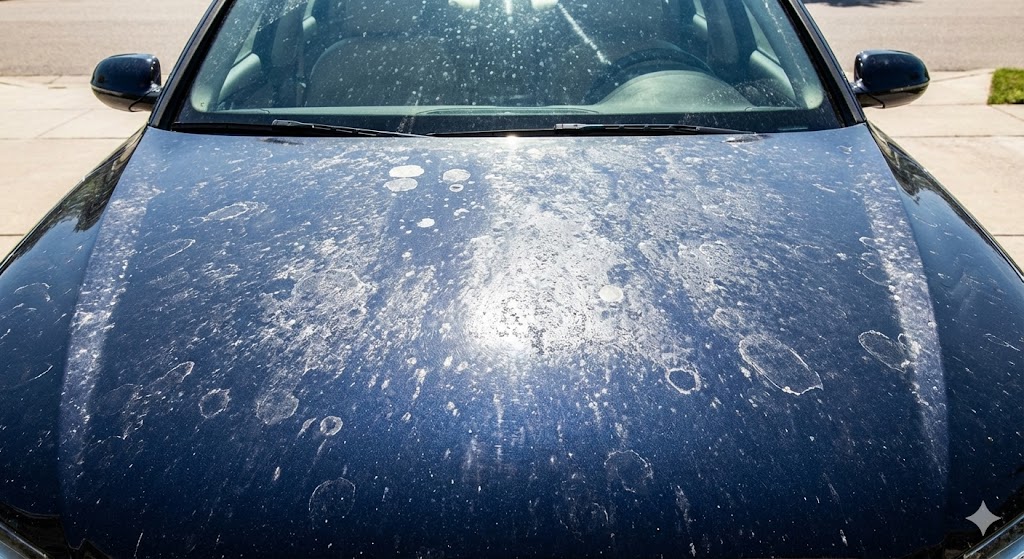
Dozens, maybe hundreds, of ugly white crusty rings dotted across your hood and windows.
Water spots. The arch-nemesis of a clean car.
In 2026, with acid rain and increasingly “hard” tap water, water spots are more than just an annoyance. If left untreated, they can permanently damage your car’s clear coat, leading to expensive repairs.
But don’t panic and grab a kitchen scouring pad.
This comprehensive guide will explain exactly what water spots are, how to diagnose the severity of yours, and provide safe, step-by-step methods to banish them from your paint and glass forever—from simple DIY vinegar hacks to professional polishing techniques.
1. The Science: What ARE Water Spots? (And Why They Are Dangerous)
Water spots are not actually “water.” They are what the water leaves behind.
Tap water (and rain that falls through dirty air) is full of dissolved minerals—calcium, magnesium, and limestone. This is known as “hard water.”
When a drop of hard water sits on your warm car paint, the water evaporates. But the minerals do not. They crystallize onto your paint, leaving that crusty white ring.
The “Magnifying Glass” Effect
The real danger happens when the sun comes out. A rounded bead of water acts like a magnifying glass, focusing intense solar heat onto a tiny pinpoint on your clear coat. This heat, combined with the alkaline minerals, literally burns a crater into your paint.
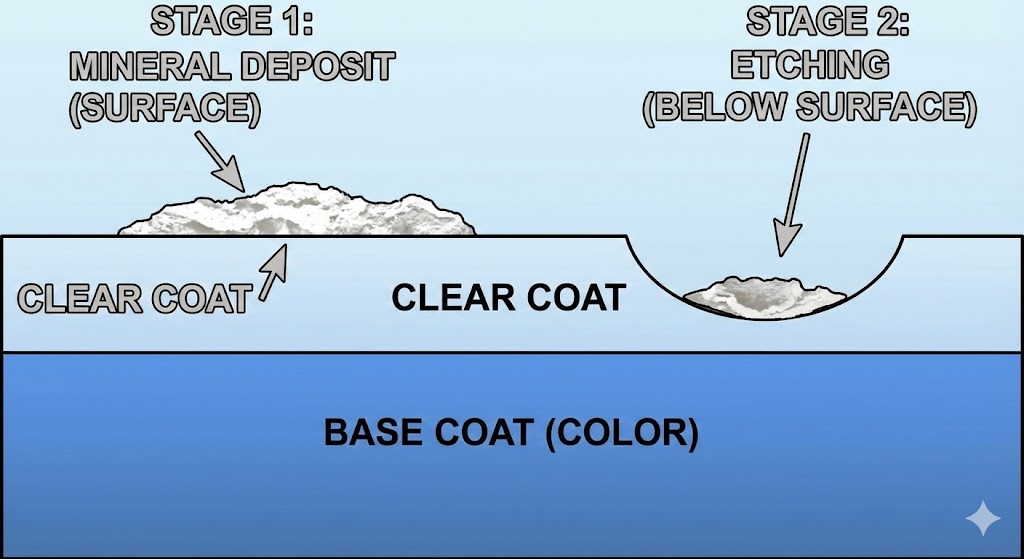
Once a spot has etched into the paint, you can no longer “clean” it off. You have to physically level the paint surrounding it.
2. The Diagnosis: Are Your Spots “Stage 1” or “Stage 2”?
Before you choose a removal method, you must know what you are dealing with.
The “Baggie Test”: Wash and dry a small section of the affected area. Put your hand inside a thin plastic sandwich bag and gently glide your fingertips over the spots.
Stage 1: Mineral Deposits (Surface Level)
Feel: Rough, bumpy, crusty. You can feel them snagging the plastic bag.
Appearance: White, chalky rings sitting on top of the paint.
Solution: Chemical removal (Vinegar, Water Spot Remover, Clay Bar).
Stage 2: Etching (Below Surface)
Feel: Smooth or slightly indented. Your finger dips into a tiny crater.
Appearance: Looks like a colorless “ghost” ring burned into the clear coat.
Solution: Mechanical abrasion (Hand or machine polishing).
3. Method A: The DIY Vinegar Hack (For Stage 1 Deposits)
This is the most popular home remedy. White distilled vinegar is mildly acidic, which helps dissolve alkaline mineral deposits.
WARNING: Vinegar can strip existing wax and dry out rubber seals. NEVER do this in direct sunlight or on hot paint.
Steps:
Wash the Car: Never wipe a dirty car. Perform a standard hand wash first.
Mix Solution: In a spray bottle, mix a 1:1 ratio of distilled white vinegar and distilled water.
Soak a Towel: Spray the solution onto a clean microfiber towel until damp. Do not spray directly onto the car (to avoid overspray on trim).
Apply & Dwell: Place the damp towel over the water spots and let it sit for 3-5 minutes. Do not let it dry.
Wipe & Neutralize: Gently wipe the area. Immediately rinse thoroughly with water to neutralize the acid.
Re-Protect: You have likely stripped your wax. Apply a new layer of spray wax or sealant immediately.
4. Method B: Dedicated Water Spot Removers (Chemical Warfare)
If vinegar doesn’t work, you need stronger chemistry. Products like CarPro Spotless, Gyeon WaterSpot, or Chemical Guys Heavy Duty Water Spot Remover are formulated specifically for this.
They use stronger acids (often mild hydrofluoric or sulfuric acid derivatives) designed to break down stubborn calcium bonds quickly.
Steps:
Read Directions: Every product is different. Follow dwell times precisely.
Wear Gloves: These chemicals can irritate skin.
Work in Sections: Apply to a small 2×2 foot area via an applicator pad.
Agitate Gently: Work the product in a cross-hatch pattern.
Rinse Immediately: Do not let these products dry on the paint. Rinse very thoroughly.
5. Method C: The Clay Bar (Mechanical Decontamination)
If the spots are stubborn but still feel “above surface,” a clay bar treatment might shear them off.
Steps:
Lubricate: Spray the area generously with clay lubricant or quick detailer.
Glide: Gently glide the clay bar back and forth over the spots. Do not apply pressure; let the clay do the work.
Check: You will feel the clay grabbing the contaminants. Keep going until the paint feels smooth as glass.
Note: Claying often causes “marring” (micro-scratches). You should usually follow up with a light polish.
6. Method D: Polishing (The Nuclear Option for Stage 2 Etching)
If you did the “Baggie Test” and felt craters, or if Methods A, B, and C failed, your spots are etched. No chemical will fix this. You must remove a microscopic layer of clear coat to level the surface.
Hand Polishing: Possible for small areas, but tiring. Use a foam applicator and a finishing polish (like Meguiar’s Ultimate Polish). Work in small circles with moderate pressure until the spot fades.
Machine Polishing (DA Polisher): The professional way. Use a Dual Action Polisher with a medium foam pad and polish. This is part of a full Paint Correction process (often done before applying PPF or ceramic coatings).
7. Special Zone: How to Clean Water Spots off Car Glass
Glass is much harder than paint, so you can be a bit more aggressive. Water spots on windshields are annoying and dangerous when driving into the sun.
The 0000 Steel Wool Trick (Glass ONLY!):
Buy “0000” Grade: It must be Ultra Fine #0000 steel wool. Anything coarser will scratch the glass.
Lubricate: Spray the glass with window cleaner or vinegar solution.
Scrub: Gently scrub the wet glass with the steel wool pad. The minerals will crunch right off.
Warning: Do NOT touch painted trim or side mirrors (which are often plastic, not glass) with steel wool.
Finish: Clean normally. See our How to Clean Car Windows Guide for streak-free tips.
8. Prevention: Stop Them Before They Start
Removing water spots is awful. Preventing them is easy.
Never Wash in Direct Sun: Hot paint flash-dries water before you can towel it off. Always wash in the shade or early/late in the day.
Ditch the Chamois: Old-school leather chamois tend to drag water. Use modern, large twisted-loop microfiber drying towels or a dedicated car air blower to dry fast.
Upgrade Your Protection: A bare car spots easily. A good sealant or wax helps bead water so it rolls off. The ultimate protection is a Ceramic Coating, which is extremely hydrophobic and makes drying effortless.
Conclusion
Water spots are a pain, but they aren’t invincible.
Start with the least aggressive method (vinegar) and work your way up. The key is patience and diagnosis. If you catch them early, they are a 10-minute fix. If you let them bake in the summer sun for months, you’re looking at a full weekend of polishing.
Don’t let hard water ruin your hard work.

